

Description
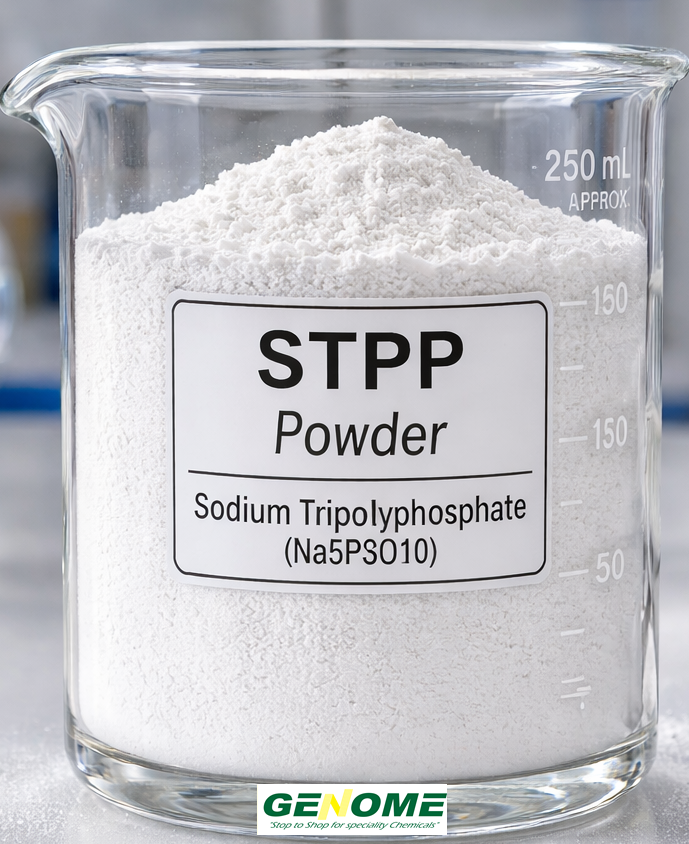
Genome Specialities is a trusted STPP supplier providing high-quality Sodium Tripolyphosphate (STPP) for a wide range of industrial and commercial applications. known as sodium triphosphate .
widely used in detergent manufacturing, water treatment, food processing, and chemical formulations.
Sodium Tripolyphosphate (STPP) is an inorganic sodium phosphate compound with the chemical formula Na₅P₃O₁₀ ,white crystalline or granular powder and dissolves readily in water.
Chemical properties of STPP
| Property | Description |
| Chemical Name | Sodium Tripolyphosphate |
| Chemical Formula | Na₅P₃O₁₀ |
| Molar Mass | 367.86 g/mol |
| Appearance | White crystalline powder |
| Density | 2.52 g/cm³ |
| Melting Point | 622 °C |
| Solubility in Water | 14.5–20 g/100 mL at 25 °C |
| pH (1% solution) | 9.0–10.3 |
| Odor | Odorless |
| Hygroscopic | Yes (absorbs moisture from air) |
Major Applications of Sodium Tripolyphosphate
STPP for Detergent Manufacturing
Detergent manufacturing is one of the major applications of STPP. Sodium tripolyphosphate acts as a builder that helps soften hard water by binding calcium and magnesium ions.
This helps detergents perform more effectively by reducing the interference of hardness minerals with surfactants.
STPP can help:
- Improve detergent cleaning performance
- Soften hard water
- Control mineral deposits
- Improve soil dispersion
- Enhance surfactant efficiency
Genome Specialities supplies STPP for applications in laundry detergents, industrial cleaners, and other cleaning formulations, subject to the applicable product specification.
STPP for Water Treatment
It can help control mineral deposits and reduce the effects of hard-water components in:
- Industrial water systems
- Cooling systems
- Boiler systems
- Process-water applications
- Pipeline systems
The appropriate STPP dosage depends on water chemistry, system conditions, and application requirements.
STPP for Food Processing
Food-grade STPP (E451) is used in permitted food-processing applications as a functional ingredient. It can act as a moisture-retention agent, stabilizer, emulsifying salt, and texturizing aid.
In certain processed meat and seafood applications, STPP can help improve moisture retention and maintain desirable texture.
Food-grade STPP must comply with the applicable food regulations and quality standards for the intended market and application.
This property makes STPP valuable in formulations where controlling mineral ions is important. By managing these ions, STPP can help reduce mineral deposits and improve formulation performance.
STPP as a pH-Buffering Agent
STPP contributes to maintaining an alkaline environment in aqueous formulations. This makes it useful in detergent and cleaning formulations where an alkaline environment supports effective cleaning.

Reviews
There are no reviews yet.