
Description
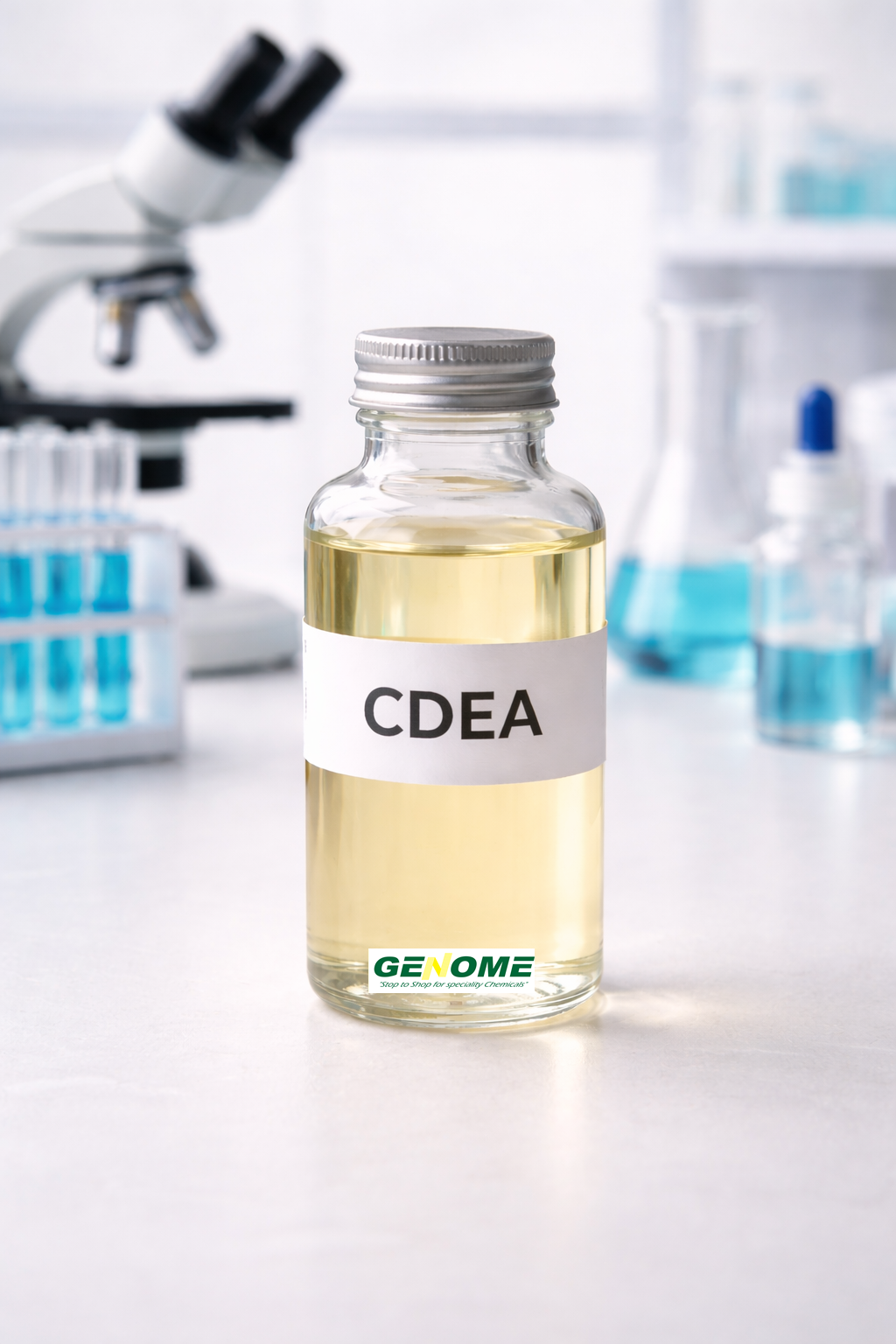
Genome Specialities FZC supplies premium-quality Cocamide Diethanolamine (CDEA) in the UAE, also known as Cocamide DEA or Cocodiethanolamide. CDEA is a versatile nonionic surfactant derived from coconut-based fatty acids and diethanolamine, widely used for its excellent foaming, thickening, emulsifying, and cleaning-enhancing properties.
Cocamide DEA is suitable for a wide range of applications, including personal care products, household cleaners, industrial detergents, textile processing, and leather treatment formulations, helps manufacturers improve foam stability, viscosity, formulation consistency, and overall cleaning performance.
Chemical & Physical Properties of Genome Specialities FZC CDEA
| Property | Specification / Value |
|---|---|
| Chemical Name | Cocamide DEA |
| INCI Name | Cocamide DEA |
| CAS Number | 68603-42-9 |
| Chemical Nature | Nonionic surfactant / foam booster |
| Appearance | Pale yellow to amber viscous liquid or semi-solid |
| Odor | Mild, characteristic fatty odor |
| Active Matter | ~85–90% |
| pH (10% solution) | 9.0 – 11.0 |
| Solubility | Dispersible in water; soluble in alcohol |
| Specific Gravity @ 25°C | 0.95 – 1.00 |
| Viscosity @ 25°C | High (varies with grade and temperature) |
| Ionic Nature | Nonionic |
| Cloud Point | Not applicable (nonionic surfactant) |
| Flash Point | >200 °C |
| Stability | Stable under normal conditions; avoid strong acids |
| Compatibility | Compatible with anionic, nonionic, and amphoteric surfactants |
| Biodegradability | Biodegradable |
| Functionality | Foam booster, viscosity enhancer, emulsifier |
Key Benefits of Genome Specialities Fzc Cocamide DEA
Enhances foam volume and stability
Improves viscosity and product texture
Supports efficient grease and oil removal
Stabilizes emulsions and formulations
Compatible with various surfactant systems
Biodegradable and environmentally friendly
Suitable for personal care and industrial formulations
Applications and Uses of Genome CDEA
Personal Care Industry
Genome Specialities Cocamide DEA enhances the performance of shampoos, body washes, facial cleansers, liquid soaps, and shaving creams by delivering rich, stable foam and improved viscosity. CDEA is a highly effective foam booster, it creates a creamy and luxurious lather that elevates the overall user experience.
Additionally, Cocamide DEA improves formulation thickness and consistency, allowing manufacturers to achieve the desired product texture with minimal use of additional thickening agents. Moreover, it works efficiently with a wide range of surfactant systems, making it a versatile ingredient for personal care formulations.
Beyond its thickening capabilities, Cocamide DEA helps stabilize emulsions and maintain formulation integrity throughout storage. Consequently, products retain their appearance, performance, and uniform texture over time. Therefore, manufacturers can develop high-quality personal care products that offer excellent shelf stability, enhanced consumer appeal, and reliable performance
Common Applications:
- Shampoos
- Body Washes
- Facial Cleansers
- Liquid Hand Soaps
- Shaving Creams
- Bubble Baths
Household Cleaning Industry
In dishwashing liquids, laundry detergents, and surface cleaners, CDEA plays an important role in foam stabilization and grease removal. It works synergistically with anionic surfactants to maintain stable foam even in the presence of oils, fats, and hard water.
By enhancing emulsification, CDEA helps break down and suspend oily dirt, allowing it to be rinsed away more effectively.
CDEA improves grease-cutting performance and helps suspend dirt particles for easier rinsing.
Industrial Cleaning Applications
In degreasers, car wash detergents, and foaming floor cleaners, CDEA is valued for its ability to boost cleaning strength in heavy-duty formulations.
For industrial cleaning applications, Genome Specialities Cocamide DEA delivers superior cleaning performance in demanding environments.
CDEA improves formulation stability, supports dense foam generation for better surface contact, and enhances the emulsification of heavy grease, resulting in improved cleaning performance without compromising product stability.
Textile & Leather Industry
In textile and leather processing, CDEA is used in cleaning, dyeing, and finishing agents. It helps remove natural oils, waxes, and processing residues from fibers and hides, ensuring uniform dye penetration and consistent finishing results.
Its emulsifying properties assist in dispersing dyes and chemicals evenly, improving fabric quality, color uniformity, and softness. CDEA contributes to smoother processing and improved final product appearance
Grade Comparison
| Grade / Ratio | Active Matter (%) | Free Amine (DEA) | pH (1 % sol.) | Use Case |
| CDEA‑85 (1:1) | ≥ 85 % | ≤ 5 % | 9.0–11.0 | High-performance thickener/emulsifier |
| CDEA ~77–80 % (1:1.5–1:2) | ≥ 70–77 % | Higher | ~9.5–10.5 | Cost-efficient general-purpose use |
| Lower ratio blends | 63–70 % | Could reach ≤ 130 mgKOH/g | ~9.5–10.7 | Mainly industrial, less refined formulation |
Reviews
There are no reviews yet.