
Description
Citric Acid Anhydrous is a high-quality organic acid widely used in the food, beverage, pharmaceutical, cosmetic, and industrial sectors.
As a water-free form of citric acid, it offers excellent stability, high purity, and extended shelf life, making it a preferred choice for manufacturers and industrial applications.
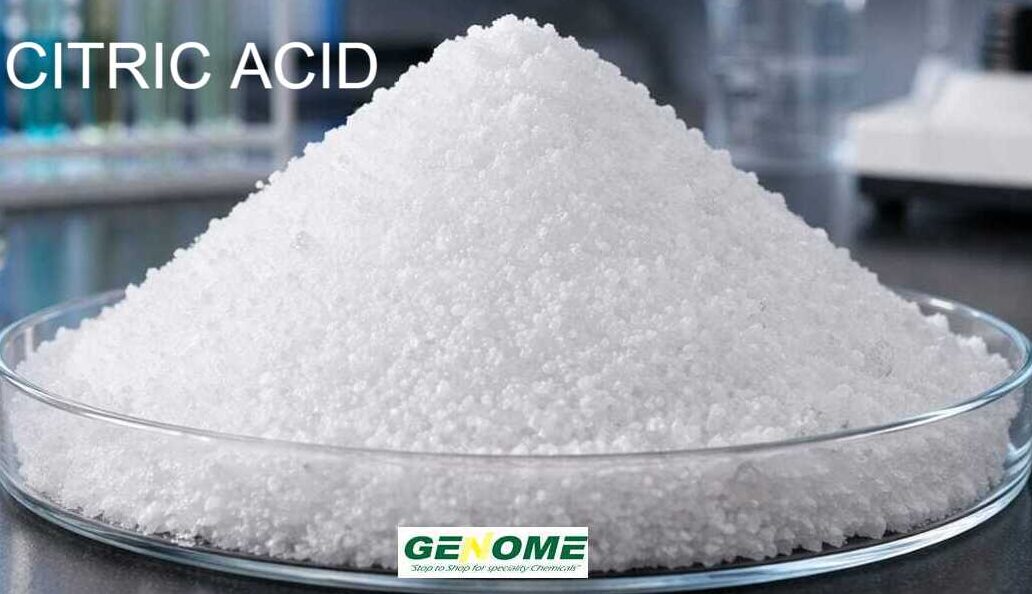
Citric Acid Anhydrous appears as a white crystalline powder with a strong acidic taste and excellent solubility.
Its chemical formula is C₆H₈O₇, and it is commonly used as an acidulant, preservative, pH regulator, chelating agent, and flavor enhancer.
Genome Specialities fzc is a trusted supplier for citric acid in UAE provide premium-quality products that meet industry standards and customer requirements.
Food, beverage, pharmaceutical, cosmetic and industrial sectors rely on Citric Acid Anhydrous as a high-quality organic acid.
Properties and Key Differences between Citric acid anhydrous and Monohydrate
Citric acid exists in two main forms: anhydrous and monohydrate.
The key distinction between them is the presence of a water molecule.
| Property | Citric Acid Anhydrous | Citric Acid Monohydrate |
| Chemical Formula | C₆H₈O₇ | C₆H₈O₇·H₂O |
| Molecular Weight | 192.12 g/mol | 210.14 g/mol |
| Water Content | None (water-free) | One water molecule per molecule of citric acid |
| Appearance | Fine, white powder or crystals | Larger, more transparent crystals |
| Melting Point | Approximately 153°C (307°F) | Approximately 135°C (275°F) |
| Production | Crystallization from a hot, concentrated solution | Crystallization from a cold aqueous solution |
Common Grades of Citric Acid
- Food Grade / Preservative Grade (FCC):
most common grade of citric acid, which is used extensively in the food and beverage industry.
It serves as an acidulant to provide a tart flavor, a preservative to prevent microbial growth, and a chelating agent.
used in soft drinks, candies, processed foods, and canned goods.
The purity is typically very high, often 99.5% to 100.5%. The Food Chemicals Codex (FCC) sets the quality standards for this grade.
- Pharmaceutical Grade (USP/BP/Ph. Eur.):
used in medicines and dietary supplements as a stabilizer, preservative, and to enhance the absorption of minerals.
used to adjust the pH of pharmaceutical formulations.
- Reagent / Laboratory Grade (ACS):
- Industrial / Technical Grade:
This grade has a lower assay of citric acid (around 96-97%) compared to the other grades.
used in non-food and non-pharmaceutical applications where a high level of purity is not required.
Common uses include detergents, cleaning agents, water softeners.
Uses and Applications
Manufacturers across various industries use citric acid anhydrous for a wide range of applications.
Its properties as an acidulant, preservative, and chelating agent make it highly valuable.
- Food and Beverage:
Food manufacturers commonly add it as a natural preservative and to provide a tart or sour flavor.
It also acts as a chelating agent, preventing unwanted flavor or color changes.
2. Pharmaceuticals:
The pharmaceutical industry uses it as a pH adjuster and stabilizer in a variety of medications, including effervescent tablets and oral solutions
3.Cosmetics and Personal Care:
It helps to balance the pH of products like creams and lotions.
Some skin care products also use it for its exfoliating properties because it is an alpha hydroxy acid (AHA)
4. Cleaning Products:
Due to its acidic nature, it is an effective and environmentally friendly cleaning agent.
Descalers, bathroom cleaners, and detergents uses citric acid to remove mineral deposits, limescale, and rust.
It can also act as a water softener.

Reviews
There are no reviews yet.