Description
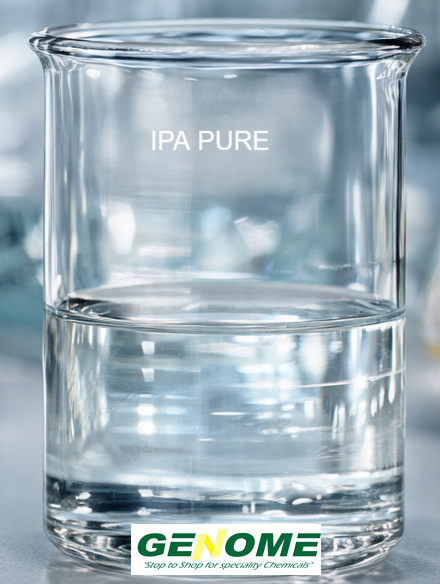
Isopropyl Alcohol (IPA), also known as Isopropanol or 2-Propanol, is a clear, colorless, highly volatile and flammable liquid with a characteristic alcoholic odor.
IPA Pure generally refers to high-purity Isopropyl Alcohol, commonly supplied at 99% or higher concentration, depending on the product specification and intended application.
Genome Specialities supplies Isopropyl Alcohol for a wide range of industrial, commercial, and specialty applications, with grades and specifications selected according to customer requirements.
Chemical Properties
| Property | Description |
| Chemical name | Isopropyl alcohol (2-propanol) |
| Molecular formula | C₃H₈O |
| Appearance | Clear, colorless liquid |
| Odor | Characteristic alcoholic odor |
| Taste | Burning (not for tasting) |
| State | Liquid |
| Density | ~0.785 g/mL (at 20 °C) |
| Boiling point | ~82.5 °C |
| Melting point | ~−89 °C |
| Volatility | Volatile |
| Solubility in water | Completely miscible |
| Solubility in solvents | Miscible with alcohol, ether, chloroform |
Applications of Isopropyl Alcohol
Electronics & Electrical Cleaning
Used for cleaning sensitive electronic and electrical components where low residue and rapid evaporation are important.
Applications include:
- Printed circuit board cleaning
- Removal of flux residues
- Cleaning electronic components
- Optical and precision equipment cleaning
- General electronics maintenance
The appropriate electronics-grade specification should be selected for sensitive semiconductor and high-precision applications.
Industrial Cleaning & Degreasing
used as a solvent for removing:
- Oils
- Greases
- Adhesive residues
- Dirt and contaminants
- Fingerprints
- Light surface residues
used in manufacturing facilities, workshops, maintenance operations, and industrial cleaning processes.
Pharmaceutical Industry
Used in pharmaceutical manufacturing and processing as a solvent, processing aid, and cleaning agent.
Pharmaceutical applications require the use of a grade that complies with the applicable regulatory and pharmacopoeial requirements.
Medical & Disinfection Applications
Used in certain disinfectant and antiseptic formulations.
The suitability of a product for medical or antiseptic use depends on its grade, formulation, regulatory status, and intended application.
Laboratory Applications
Used in laboratories for:
- Cleaning laboratory equipment
- Sample preparation
- General solvent applications
- Surface cleaning
- Analytical and research processes
For analytical applications, the appropriate reagent or analytical grade should be selected according to the method requirements.
Cosmetics & Personal Care
Used as a solvent or processing ingredient in selected cosmetic and personal-care formulations.
Applications may include:
- Formulation processing
- Cleaning of manufacturing equipment
- Selected cosmetic and personal-care products
Printing, Coatings & Adhesivessed as a solvent and processing aid in selected:
- Printing ink systems
- Coatings
- Adhesives
- Surface-treatment formulations
Its fast evaporation and solvency characteristics make it useful in formulations where controlled drying is required.
Automotive & Maintenance
IPA is used for selected automotive and maintenance applications, including surface preparation and removal of oils, residues, and contaminants.
Isopropyl Alcohol Grades
Isopropyl Alcohol is available in different grades depending on purity, impurity limits, regulatory requirements, and intended application. Important specification parameters may include IPA assay, water content, acidity, residue after evaporation, carbonyl compounds, and other trace impurities.
Technical / Industrial Grade
Technical or industrial-grade IPA is intended for general industrial applications where pharmaceutical, food, or analytical-grade specifications are not required.
Typical purity: Approximately 99% or higher, depending on the manufacturer’s specification.
Applications
- Industrial cleaning
- Degreasing
- Manufacturing processes
- Surface preparation
- General-purpose solvent applications
- Chemical processing
USP / Pharmaceutical Grade
Pharmaceutical-grade Isopropyl Alcohol is manufactured and tested according to the applicable pharmaceutical quality requirements and, where applicable, relevant pharmacopoeial standards such as USP/NF or equivalent standards.
Applications
- Pharmaceutical manufacturing
- Pharmaceutical processing
- Cleaning applications
- Selected disinfectant formulations
- Personal-care and cosmetic manufacturing
The exact purity and impurity requirements depend on the applicable pharmacopoeial standard and product specification.
ACS / Reagent Grade
ACS-grade IPA is manufactured to meet applicable American Chemical Society specifications for reagent chemicals.
It is intended for laboratory and analytical applications where controlled impurity levels are important.
Applications
- Laboratory testing
- Analytical chemistry
- Sample preparation
- Research applications
- Laboratory cleaning
HPLC / Analytical Grade
High-purity IPA may be supplied for chromatographic and analytical applications where controlled impurities and low background interference are important.
Applications
- HPLC solvent systems
- Analytical sample preparation
- Instrument and laboratory applications
- Research and development
Specific analytical specifications should be confirmed against the relevant certificate of analysis and test method.
Electronics / Semiconductor Grade
Electronics-grade IPA is produced with stringent controls on impurities that may adversely affect sensitive electronic and semiconductor manufacturing processes.
Depending on the specification, controls may include:
- Ionic contaminants
- Metallic impurities
- Particulate matter
- Water content
- Non-volatile residue
- Other trace contaminants
Applications
- Semiconductor manufacturing
- Wafer cleaning
- Electronics manufacturing
- Precision component cleaning
- High-purity surface cleaning

Reviews
There are no reviews yet.