
Description
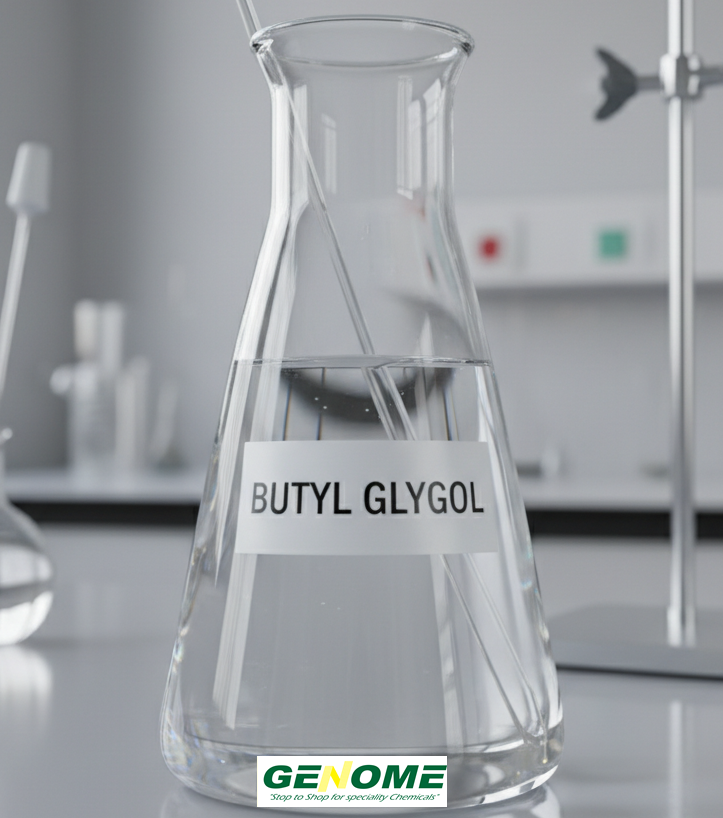
GENOME SPECIALITIES FZC supplies Butyl Glycol, also known as 2-Butoxyethanol or 2-BE, a versatile glycol ether solvent used across paints and coatings, cleaning products, printing inks, adhesives, sealants, and selected agricultural formulations.
Butyl Glycol combines good solvency, water compatibility, relatively low volatility, and excellent formulation versatility.
Its ability to dissolve or assist in dissolving oils, greases, resins, and other organic materials makes it a valuable raw material for industrial and commercial formulations.
Chemical Properties
| Property | Value |
|---|---|
| IUPAC name | 2-Butoxyethanol |
| Chemical formula | C₆H₁₄O₂ |
| Molar mass | 118.17 g/mol |
| CAS number | 111-76-2 |
| Appearance | Clear, oily liquid with mild sweet odor |
| Density | ~0.90 g/cm³ |
| Boiling point | ~171 °C |
| Melting point | −70 to −77 °C |
| Flash point | ~67 °C (closed cup) |
Applications of Butyl Glycol
- Paints and Coatings
Uses Butyl Glycol as a solvent and coalescing aid, particularly in water-based formulations.
It can help:
- Improve flow and leveling
- Enhance film formation
- Control evaporation
- Improve application properties
- Solubilize selected resins and formulation components
Used in architectural coatings, industrial coatings, primers, and other coating systems where glycol ether solvents are suitable.
- Household and Industrial Cleaners
Butyl Glycol is an important solvent for cleaning and degreasing formulations.
Common applications include:
- Glass and window cleaners
- Floor cleaners
- All-purpose cleaners
- Heavy-duty degreasers
- Industrial cleaners
- Surface-cleaning products
Its ability to combine water compatibility with organic solvency helps cleaning formulations remove oily and greasy contaminants.
- Printing Inks
The solvent properties and relatively high boiling point of Butyl Glycol make it useful in selected printing ink formulations.
It can assist with:
- Solubilizing formulation components
- Controlling drying behavior
- Improving application characteristics
- Supporting uniform ink distribution
Its suitability depends on the specific ink system and printing process.
- Adhesives and Sealants
Butyl Glycol can serve as a solvent or formulation aid in selected adhesive and sealant systems.
It may help improve:
- Application properties
- Component compatibility
- Flow
- Viscosity control
- Formulation stability
- Agricultural Formulations
Used as a solvent or formulation component in selected agricultural chemical products, including certain pesticide and herbicide formulations.
Its use depends on the active ingredient, formulation type, regulatory requirements, and compatibility of the complete system.
Butyl Glycol Grades
The appropriate Butyl Glycol grade depends on the intended application and required purity.
Technical Grade Butyl Glycol
used for industrial formulations where the product specification meets the required process and performance requirements.
Typical applications include:
- Paints and coatings
- Industrial cleaners
- Household cleaning products
- Degreasers
- Printing inks
- Adhesives
- Sealants
The exact purity and impurity profile can vary by supplier, so buyers should confirm the specification before selecting a grade.
Reagent / Analytical Grade
Potential applications include:
- Laboratory solvent systems
- Chemical research
- Analytical procedures
- Specialized manufacturing processes
The required purity should always be matched to the relevant analytical method or manufacturing specification.
Specialized Grades
Depending on the supplier and application, specialized specifications may be available for specific technical requirements.
Examples can include:
- High-purity grades
- Spectrophotometric grades
- Analytical grades
- Custom specifications

Reviews
There are no reviews yet.