
Description
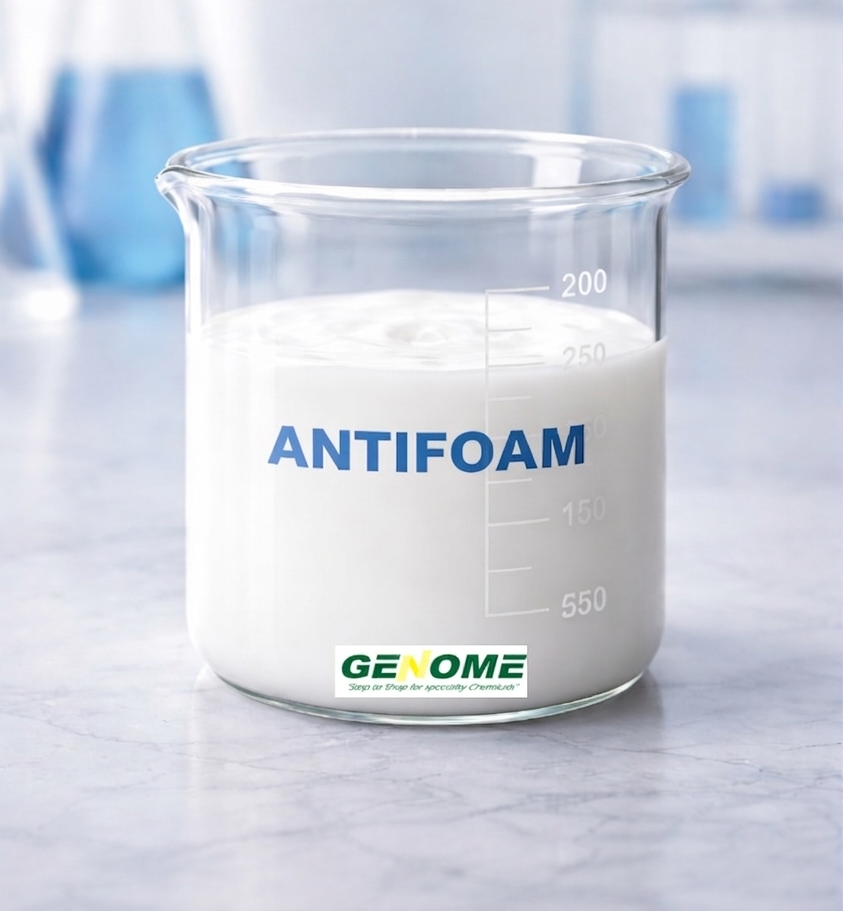
In industrial manufacturing, unwanted foam can disrupt operations, cause costly overflows, reduce equipment efficiency, and compromise product quality. At Genome Specialities FZC, we provide advanced Silicone Antifoam agents designed to rapidly eliminate and prevent foam across a diverse range of demanding processing environments.
Our specialized silicone-based formulations utilize high-purity Polydimethylsiloxane (PDMS) to deliver immediate foam knockdown and long-lasting suppression, ensuring your production lines run smoothly and efficiently.
Chemical Properties Of Antifoam / Defoamer
| Property | Description |
|---|---|
| Chemical Type | Silicone-based antifoaming agent |
| Primary Component | Polydimethylsiloxane (PDMS) |
| Chemical Formula (PDMS repeat unit) | (–Si(CH₃)₂–O–)ₙ |
| Chemical Nature | Non-ionic polymer |
| Molecular Weight | Very high, variable |
| Appearance | White to off-white emulsion or clear oil |
| Odor | Odorless or faint |
| Solubility in Water | Insoluble (emulsifiable) |
| Solubility in Organic Solvents | Dispersible in many non-polar solvents |
| pH (emulsion) | Neutral (≈6.0–8.0) |
| Ionic Character | Non-ionic |
| Surface Tension | Very low (~20–21 mN/m) |
| Foam Control Action | Rapid foam knockdown and long-lasting defoaming |
| Chemical Stability | Highly stable under normal conditions |
| Thermal Stability | Stable up to ~200–250 °C |
| Oxidizing / Reducing Nature | Neither |
| Reactivity | Inert; incompatible with strong oxidizers |
| Hydrolysis Resistance | Excellent |
| Volatility | Very low |
| Corrosiveness | Non-corrosive |
| Biodegradability | Poor / very slow |
| Toxicity | Low (food/pharma grades available) |
Common Applications of Antifoam
As a versatile process aid, Genome Specialities FZC silicone defoamers are trusted across multiple global sectors:
Wastewater Treatment:
Prevents foam buildup in aeration tanks and effluent treatment plants (ETP).
Food Processing:
Utilized in food-safe environments to control foam during washing, slicing, and fermentation.
Textiles & Detergents:
In textile Industry , it controls excessive lathering during high-speed textile dyeing and surfactant formulation.
Paints, Inks & Coatings:
Eliminates micro-foam during blending and application, ensuring smooth, defect-free finishes.
Pharmaceuticals & Biotech:
Manages foaming in bioreactors and fermentation tanks without affecting microbial cultures.
Pulp & Paper Production:
Enhances drainage and washing efficiency by suppressing foam in black liquor and paper machines.
Key Difference Between Antifoam and Defoamer
| Feature | Antifoam | Defoamer |
| Function | Prevents foam from forming | Eliminates or breaks existing foam |
| Use Timing | Added before or during the process | Added after foam has formed |
| Primary Action | Suppresses bubble formation | Breaks foam bubbles and collapses foam layer |
| Formulation | May include defoaming ingredients | Stronger surface activity for immediate effect |
| Examples | Used in cooling water systems, paints | Used in fermentation tanks, wastewater foam |
Reviews
There are no reviews yet.