


Description
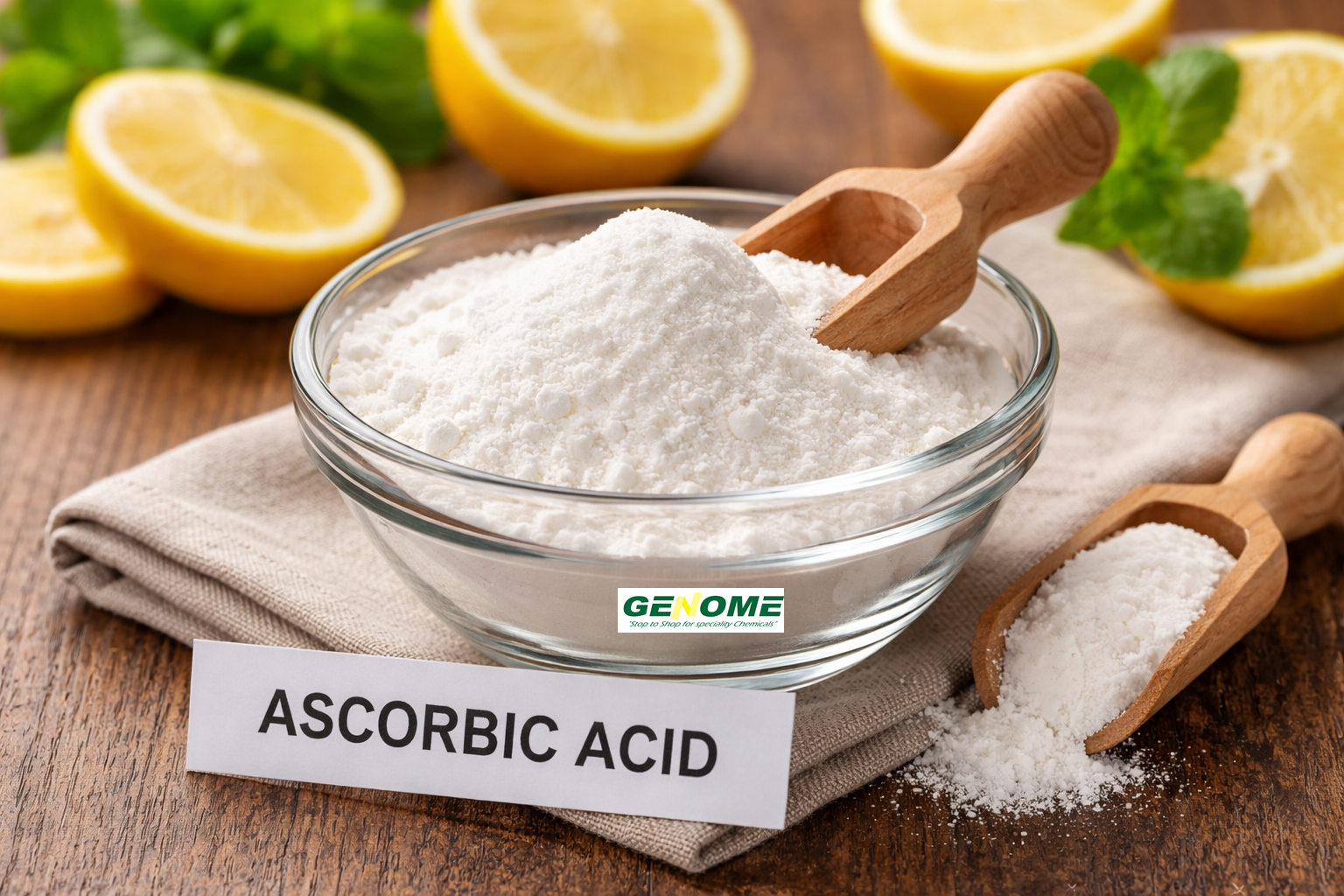
GENOME SPECIALITIES FZC is a trusted supplier of Ascorbic acid is the chemical name for vitamin C which is powerful antioxidant that protects cells from damage and is vital for several bodily functions.
Natural Sources of Ascorbic Acid
- Citrus Fruits: Oranges, lemons, grapefruit, and limes.
- Berries: Strawberries, blackcurrants, and raspberries.
- Vegetables: Bell peppers,broccoli, Brussels sprouts, cauliflower, and leafy greens.
- Other Fruits: Kiwi, papaya, cantaloupe, and mango.
- Potatoes and tomatoes.
Over view of Genome Specialities Ascorbic Acid.
Ascorbic Acid Chemical Properties
Genome specialities supply the best quality of Ascorbic Acid.
The chemical properties are mentioned below.
| Property | Details |
| Chemical Name | Ascorbic Acid |
| Common Name | Vitamin C |
| Chemical Formula | C₆H₈O₆ |
| Molar Mass | 176.12 g/mol |
| Chemical Class | Organic acid (lactone) |
| Appearance | White to off-white crystalline powder |
| Odor | Odorless |
| Taste | Strongly acidic |
| pH (5% aqueous solution) | ~2.1–2.6 |
| Solubility in Water | Freely soluble |
| Solubility in Alcohol | Slightly soluble |
| Solubility in Organic Solvents | Practically insoluble |
| Acid Strength (pKa₁) | ~4.1 |
| Reducing Properties | Strong reducing agent |
| Oxidation Behavior | Easily oxidized to dehydroascorbic acid |
| Stability | Unstable in air, light, heat, and alkaline conditions |
| Melting Point | ~190–192 °C (decomposes) |
| Hydrolysis | Stable in acidic solutions |
| Reactivity with Metals | May react with iron and copper |
| Oxidizing / Reducing Nature | Reducing agent |
| Hygroscopic Nature | Slightly hygroscopic |
| CAS Number | 50-81-7 |
Functions and Health Benefits
Genome Specialities Ascorbic acid plays a crucial role in many processes throughout the body.
Its primary functions and benefits include:
Antioxidant Properties:
Protect your cells from damage caused by harmful molecules called free radicals.
Collagen Synthesis:
Used in production of collagen, a vital protein for building and maintaining healthy skin, cartilage, tendons, bones, and blood vessels.
Wound Healing and Tissue Repair:
It’s essential for pharma companies.
Immune System Support:
It helps booster the immune system by aiding in the production and function of white blood cells.
Ascorbic acid mesh size
Mesh Size refers to the particle size of ascorbic acid powder
It indicates how fine or coarse the powder is based on the sieve openings it can pass through.
A higher mesh number corresponds to a finer powder with smaller particles.
Common mesh sizes Of Ascorbic Acid
- Ascorbic Acid with Mesh size 100 mesh:
The particle size is approximately 150 μm.
- Ascorbic Acid with Mesh size 20 to 80 mesh:
This is considered a fine granular
- Ascorbic Acid with Mesh size 325 :
This is an ultra-fine powder grade, indicating a very fine particle size.
Application based on Mesh Size:
Fine Granular Powders
Used in food and beverage production fortifying juices and cereals.
Ultra-Fine Powders:
The smaller particle size of these powders is beneficial for applications in certain pharmaceutical formulations or cosmetic production.
The smaller particles can dissolve more quickly into creams or suspensions.

Reviews
There are no reviews yet.