

Description
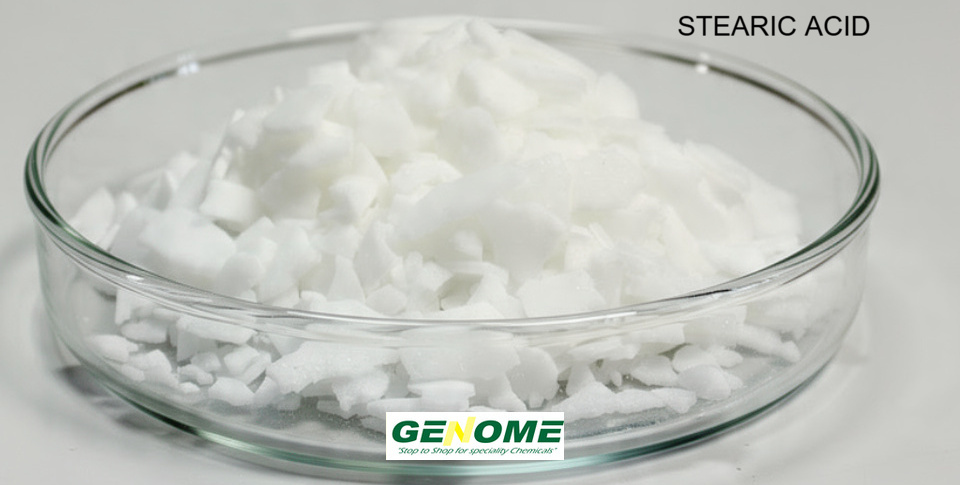
Stearic Acid is a saturated fatty acid with an 18-carbon chain and the chemical formula C₁₈H₃₆O₂.
A white, waxy solid and occurs naturally in both animal and vegetable fats and oils.
Genome Specialities fzc supplies Stearic Acid to meet the requirements of diverse industrial, rubber, plastics, cosmetics, personal care, pharmaceutical, and food applications.
Basic Chemical Information Of Stearic Acid
| Property | Value |
|---|---|
| Chemical formula | C₁₈H₃₆O₂ |
| Molar mass | 284.48 g/mol |
| Appearance | White, waxy solid |
| Odor | Mild, fatty or odorless |
| Density (20 °C) | 0.9408 g/cm³ |
| Density (70 °C) | 0.847 g/cm³ |
| Melting point | 69.3 °C |
| Boiling point | 361 °C (decomposes) |
| Solubility in water | Very low (~0.0029 g/100 g at 20 °C) |
| Solubility in organic solvents | Soluble in ethanol, acetone, chloroform, toluene, and hexane |
Stearic Acid Grades
Stearic Acid is available in different grades for specific applications. The appropriate grade depends on the required fatty-acid composition, purity, source, and regulatory requirements.
Commercial Grade Stearic Acid
Commercial Grade Stearic Acid generally contains a mixture of stearic acid and palmitic acid, with the exact composition depending on the product specification.
Typical applications include:
- Rubber processing
- Candle manufacturing
- Plastics and PVC processing
- Industrial lubricants
- Textile applications
Triple Pressed Stearic Acid
higher-quality grade with a controlled fatty-acid composition, typically offering improved color and consistency compared with lower grades.
Applications include:
- Cosmetics and personal care products
- Soaps and creams
- Pharmaceutical formulations, where the applicable grade is certified
- Food applications, where appropriate food-grade certification is available
- Rubber and plastics processing
produced from vegetable-based feedstocks such as palm-derived oils, depending on the supplier and product specification.
High-Purity Stearic Acid
Typical applications include:
- Premium cosmetics
- Personal care formulations
- Pharmaceutical applications
- Food-related applications where the required certification is available
Pharmaceutical / USP Grade Stearic Acid
Pharmaceutical-grade Stearic Acid is manufactured and controlled to meet the requirements of applicable pharmacopoeial standards, such as USP/NF or BP, where specifically certified.
Applications include:
- Tablet manufacturing
- Pharmaceutical excipients
- Ointments and creams
- Controlled-release formulations
- Other pharmaceutical manufacturing processes
Food Grade Stearic Acid
Food-grade Stearic Acid is supplied according to the applicable food regulations and specifications for the intended market and application.
Applications may include:
- Food additives
- Texture and consistency modification
- Emulsifying applications
- Dietary supplement manufacturing
- Other food-processing applications where permitted
The appropriate regulatory certification should be verified for the specific product and destination market.
Technical Grade Stearic Acid
Technical Grade Stearic Acid is primarily intended for industrial applications where pharmaceutical or food-grade specifications are not required.
Applications include:
- Industrial lubricants
- Greases
- Polishes
- Wax blends
- Rubber processing
- Plastics processing
Mold-release applications
Sources of Stearic Acid
it is derived from both vegetable and animal sources.
Vegetable-Based Stearic Acid
Vegetable-derived Stearic Acid may be produced from sources such as palm oil and other vegetable oils.
These grades are commonly considered for applications where a vegetable-derived or non-animal source is required, subject to the supplier’s certification and processing method.
Animal-Based Stearic Acid
Animal-derived Stearic Acid can be obtained from tallow and other animal fats. Such products may be used in selected industrial applications depending on customer requirements and applicable certifications.
For cosmetic, food, pharmaceutical, vegan, halal, or other regulated applications, the source and relevant certification should be confirmed before purchase.
Applications of Stearic Acid
- Cosmetics and Personal Care
Used in soaps, creams, lotions, shaving products, and other personal care formulations. It can function as a thickening and emulsifying ingredient and contributes to the desired texture and consistency of formulations.
- Soap and Detergent Manufacturing
Used in soap production to help provide hardness, structure, and desirable formulation characteristics. It is an important fatty-acid component in various personal-care and cleansing products.
- Candle Manufacturing
Used as a hardening and performance-enhancing component in candle production. It can improve candle hardness, shape retention, and burning characteristics when appropriately formulated with waxes.
- Rubber Industry
Used as a processing ingredient and activator in vulcanization systems. It can support the processing and curing characteristics of rubber compounds.
- Plastics and PVC
Used in plastics and PVC applications as a lubricant, processing aid, and formulation component. It can help improve processing characteristics and reduce friction during manufacturing.
- Pharmaceutical Applications
Used as excipients and formulation ingredients in pharmaceutical manufacturing, including tablet production and topical preparations, subject to the applicable pharmacopeial requirements.
- Food and Nutritional Applications
Used in selected food, nutritional, and dietary supplement applications where permitted by applicable regulations and where the product meets the required food-grade specifications.
- Industrial Lubricants and Polishes
Used in the manufacture of lubricants, greases, metal polishes, wax formulations, and other industrial products, where its lubricating and surface-modifying properties are beneficial.
- Mold Release and Manufacturing
Stearic Acid can function as a release agent in selected manufacturing processes, helping reduce adhesion between materials and molds or processing surfaces.


Reviews
There are no reviews yet.