
Description
Genome Specialities is a trusted Liquid Ammonia supplier, delivering high-purity industrial-grade ammonia (NH₃) for fertilizer production, refrigeration systems, chemical manufacturing, water treatment, and various industrial processes. We provide reliable supply, consistent quality, and competitive pricing to meet the demands of businesses across multiple industries.
What is Liquid Ammonia?
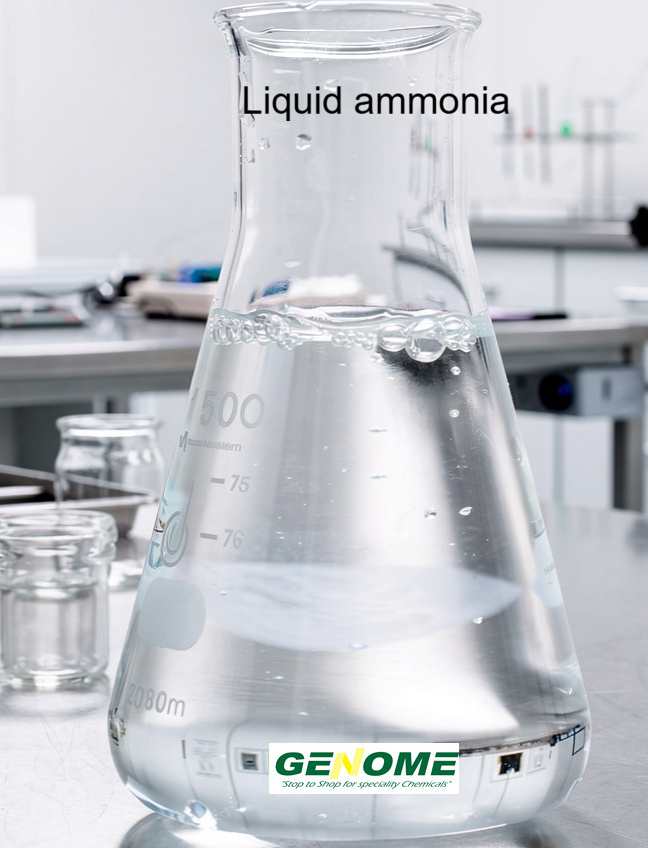
Liquid ammonia is ammonia (NH₃) in its liquid state. It is a colorless liquid with a strong, pungent odor.
Due to its excellent chemical properties and high nitrogen content, liquid ammonia plays a vital role in agriculture, manufacturing, refrigeration, and industrial processing.
Chemical properties of Liquid Ammonia
| Property | Description |
| State | Colorless liquid |
| Odor | Strong, pungent smell |
| Boiling point | −33.3 °C |
| Melting point | −77.7 °C |
| Density | 0.681 g cm⁻³ at −33 °C |
| Polarity | Highly polar |
| Hydrogen bonding | Forms hydrogen bonds |
| Electrical conductivity | Poor conductor (unless metals are dissolved) |
| Toxicity | Toxic and corrosive |
| Dielectric constant | ~22 (lower than water) |
Applications of Liquid Ammonia
Fertilizer Production:
Liquid ammonia serves as one of the most important nitrogen sources in agriculture.
Manufacturers use it to produce fertilizers such as urea, ammonium nitrate, and ammonium phosphate.
Farmers also inject liquid ammonia directly into the soil to improve crop growth and increase yields.
Refrigerant:
Liquid ammonia is a highly efficient refrigerant with excellent heat transfer properties. Industries use it in cold storage warehouses, food processing plants, ice manufacturing facilities, and large refrigeration systems because of its energy efficiency and cost-effectiveness
Chemical Manufacturing:
It serves as a raw material in the production of a variety of chemicals, including nitric acid, hydrazine, and various nitrogen-containing organic compounds.
Cleaning Agent:
It’s an active ingredient in many household and industrial cleaning products, particularly for glass and stainless steel, due to its ability to dissolve grease and grime.
Water Purification:
Water treatment facilities use liquid ammonia to produce chloramines, which extend the disinfecting effectiveness of chlorine while improving water quality and distribution system performance.

Reviews
There are no reviews yet.