
Description
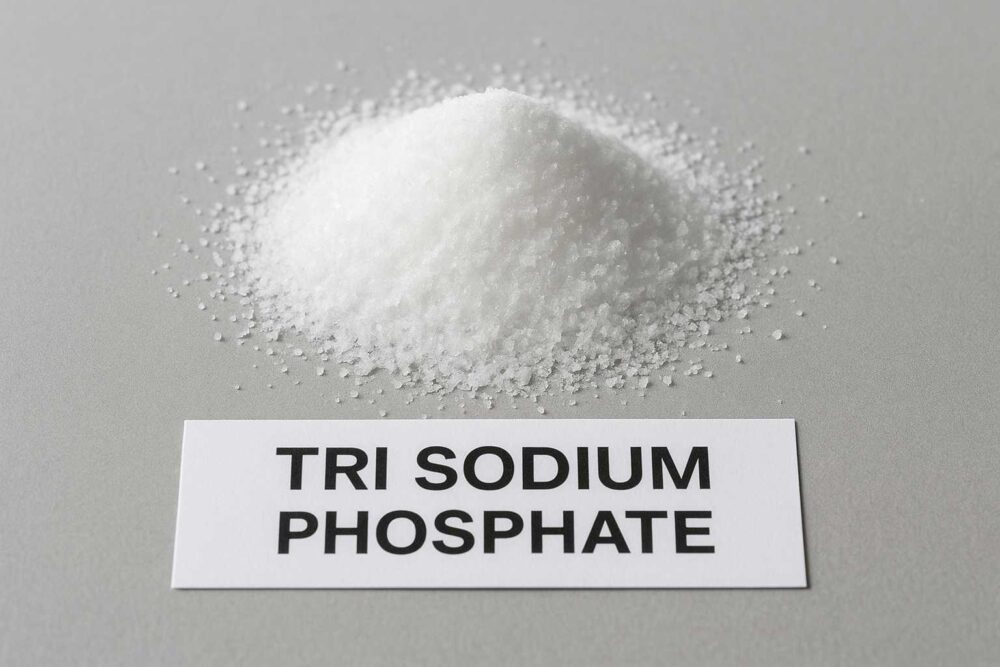
At Genome Specialities fzc we supply premium-quality Trisodium Phosphate (TSP) that meets the requirements of various industries, ensuring consistent performance and reliable quality Trisodium phosphate, commonly known as TSP, is an inorganic compound with the chemical formula Na3PO4.
It’s a white, granular or crystalline solid that’s highly soluble in water, creating a strong alkaline solution.
Its ability to act as a powerful cleaning agent and a food additive makes it a versatile substance with diverse applications.
Chemical Properties of Tri Sodium Phosphate
| Property | Value |
|---|---|
| Chemical formula | Na₃PO₄ |
| Molar mass | 163.94 g/mol (anhydrous) 212.07 g/mol (dodecahydrate) |
| Appearance | White crystalline powder or granules |
| Odor | Odorless |
| Density | Anhydrous: ~2.536 g/cm³ Dodecahydrate: ~1.62 g/cm³ |
| Melting point | ~1583 °C (anhydrous) |
| Solubility in water | Highly soluble — about 12 g per 100 mL at 25 °C |
| pH of 1% solution | ~11.5–12.5 (strongly alkaline) — literature notes around pH 12 for a 1% solution |
Trisodium phosphate is valued for its unique properties and is used across various applications:
Key Uses of Trisodium Phosphate (TSP)
- Heavy-Duty Cleaning and Degreasing
Trisodium Phosphate is widely recognized as one of the most effective industrial cleaning agents. Its strong alkalinity helps break down grease, oils, and stubborn dirt into water-soluble compounds, making surfaces easier to clean.
Common cleaning applications include:
- Surface preparation before painting
- Cleaning walls and removing grease
- Degreasing ovens and grills
- Cleaning concrete floors and driveways
- Removing mildew and stubborn stains
- Industrial equipment cleaning
Because of its exceptional cleaning performance, TSP is frequently used in construction, manufacturing, maintenance, and facility management.
- Surface Preparation for Painting
Trisodium Phosphate is used by Professional painters to clean and degloss walls before applying fresh paint.
Removing dirt, grease, and residue improves paint adhesion and results in a smoother, longer-lasting finish.
- Food Industry Applications
Food-grade Trisodium Phosphate is approved for specific food-processing applications and is recognized as Generally Recognized as Safe (GRAS) when used according to regulatory guidelines.
In the food industry, TSP functions as:
- Emulsifier – Stabilizes mixtures of oil and water.
- pH Regulator – Maintains the desired acidity level in foods and beverages.
- Thickening Agent – Improves texture and consistency.
- Preservative – Helps extend shelf life by reducing microbial growth.
It is commonly used in processed cheese, cereals, processed meats, sauces, and beverage production.
Benefits of Trisodium Phosphate
Trisodium Phosphate offers several advantages, including:
- Powerful grease and oil removal
- Fast-acting cleaning performance
- Excellent water solubility
- Effective stain removal
- Reliable pH control
- Improved paint adhesion
- Versatile industrial and food-processing applications


Reviews
There are no reviews yet.