

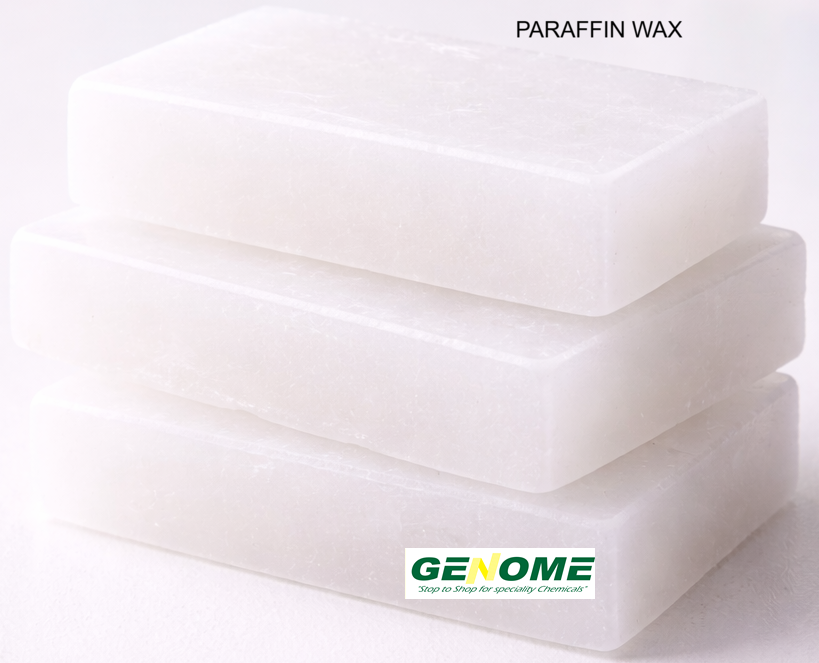

Description
Genome Specialities FZC is a trusted paraffin wax supplier offering premium-quality paraffin wax for industrial, commercial, and household applications.
Paraffin wax is a white or colorless, soft solid wax that is odorless, tasteless, and highly water-resistant.
It melts easily and burns cleanly, making it the preferred choice for candles, cosmetics, food packaging, pharmaceuticals, coatings, rubber, textiles, lubricants, and electrical insulation.
Whether you require bulk paraffin wax, industrial paraffin wax, or high-purity paraffin wax, Genome Specialities fzc delivers reliable quality and consistent performance
Chemical Properties of Paraffin Wax
| Property | Description |
| Chemical formula | Mixture of alkanes: CₙH₂ₙ₊₂ (typically C20–C40) |
| Chemical nature | Non-polar, saturated hydrocarbons |
| Reactivity | Chemically inert; low reactivity with most substances |
| Acid/Base reaction | Does not react with acids or bases |
| Water solubility | Insoluble in water |
| Solubility in solvents | Soluble in benzene, chloroform, ether, oils |
| Combustibility | Burns to produce CO₂ + H₂O; highly combustible |
| Melting behavior | Melts at 46–68°C; mixture → no sharp melting point |
| Oxidation | Slowly oxidizes in air at high temperature |
| Electrical conductivity | Excellent electrical insulator (non-conductive) |
| Polarity | Non-polar hydrocarbon |
| Stability | Stable under normal conditions; does not degrade easily |
Applications & Uses of Paraffin Wax
Cosmetics & Personal Care
JJJ paraffin wax is widely used in cosmetic and skincare products including:
- Lip balms
- Body creams
- Moisturizers
- Lotions
- Hair care products
- Beauty treatments
- Paraffin spa therapy
Its moisture-locking properties help soften and protect the skin.
Packaging Industry
Paraffin wax provides moisture resistance and grease protection for:
- Wax-coated paper
- Corrugated boxes
- Cardboard
- Food wrappers
- Cheese coatings
- Fruit coatings
- Candy packaging
Rubber & Tire Industry
Industrial paraffin wax improves rubber performance by:
- Preventing surface cracking
- Enhancing flexibility
- Improving durability
- Increasing weather resistance
Textile Industry
Paraffin wax is used in textile finishing to:
- Improve fabric feel
- Reduce friction
- Waterproof fabrics
- Coat yarns and threads
Pharmaceutical Industry
Pharmaceutical-grade paraffin wax is commonly used in:
- Tablet coatings
- Ointments
- Suppositories
- Medical creams
Its chemical stability ensures safe and reliable pharmaceutical formulations.
Polishes & Surface Coatings
Paraffin wax is an essential ingredient in:
- Shoe polish
- Furniture polish
- Floor polish
- Protective coatings
- Waterproof finishes
Art & Stationery
Paraffin wax is used for manufacturing:
- Crayons
- Wax crayons
- Encaustic paints
- Wax modeling materials
Food Industry
Food-grade paraffin wax helps preserve freshness by coating:
- Cheese
- Fruits
- Candies
- Chocolates
It reduces moisture loss and protects food during storage.
Electrical & Electronics
Due to its excellent insulating properties, paraffin wax is used for:
- Electrical insulation
- Wire coating
- Transformer sealing
- Electronic components
Lubricants & Industrial Greases
Paraffin wax enhances:
- Lubricants
- Greases
- Mold-release agents
- Industrial processing aids
Industrial Protection
Industrial paraffin wax provides:
- Corrosion protection
- Metal surface coating
- Waterproof barriers
- Mold casting applications
Grades of Paraffin wax
Fully Refined Paraffin Wax
Oil Content is Less than 0.5%.
Appearance: White, odorless, high purity
Melting Point: 46°C–68°C
Applications:
- Premium candles
- Cosmetics
- Food packaging
- Pharmaceuticals
- Polishes
Fully refined paraffin wax is the highest-quality grade, offering excellent appearance, purity, and performance.
Semi-Refined Paraffin Wax
Oil Content: 0.5%–1.5%
Appearance: Slight yellow tint
Melting Point: 46°C–68°C
Applications:
- Packaging
- Industrial coatings
- Adhesives
- General manufacturing
Semi-refined paraffin wax offers an economical solution for industrial applications.
Slack Wax
Oil Content: High
Appearance: Yellow to dark, semi-solid
Applications:
- Wax refining
- Rubber processing
- Industrial lubricants
- Protective coatings
Slack wax serves as the primary raw material for manufacturing refined paraffin wax.
Microcrystalline Wax
Melting Point: 60°C–90°C
Characteristics:
- Flexible
- Fine crystal structure
- Excellent adhesion
Applications:
- Cosmetics
- Adhesives
- Rubber
- Ointments
- Flexible coatings
Microcrystalline wax provides superior flexibility compared to standard paraffin wax.
Hard Paraffin Wax
Melting Point: 60°C–70°C+
Features:
- High hardness
- Heat resistance
- Structural strength
Applications:
- Pillar candles
- Industrial coatings
- Waterproof products
Soft Paraffin Wax
Melting Point: 46°C–58°C
Features:
- Soft texture
- Easy blending
- Low melting point
Applications:
- Cosmetics
- Food coatings
- Pharmaceutical ointments
At Genome Specialities FZC , we supply premium-quality paraffin wax tailored to meet the needs of manufacturers across multiple industries. Our products offer:
- High purity and consistent quality
- Reliable melting performance
- Excellent water resistance
- Clean-burning characteristics
- Competitive pricing
- Bulk supply capability
- Multiple grades and melting points
- Fast and dependable delivery
- Industrial and export-quality standards


Reviews
There are no reviews yet.