

Description
Genome Specialities FZC is a trusted supplier of premium-quality Titanium Dioxide (TiO₂) for diverse industrial applications.
We provide carefully sourced and quality-tested TiO₂ grades that deliver excellent whiteness, opacity, UV resistance, and consistent performance.
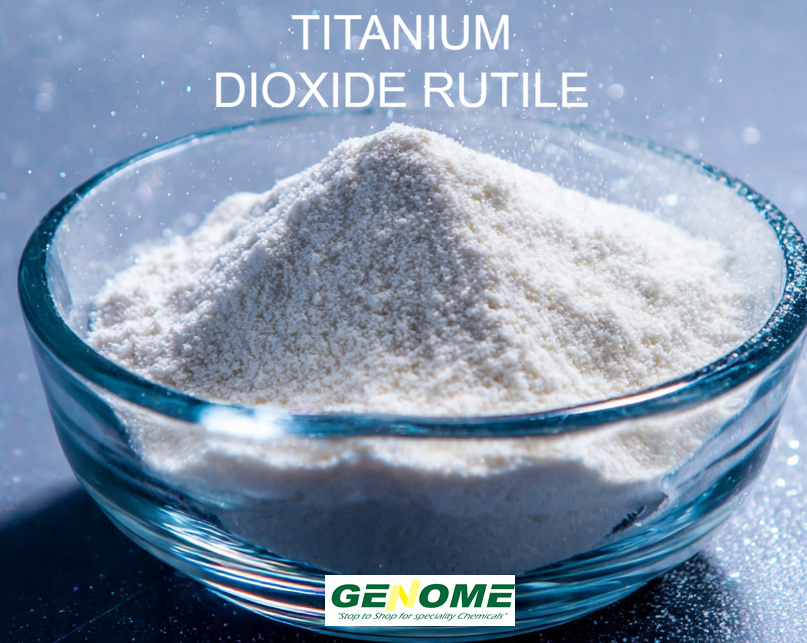
Titanium dioxide (TiO₂) is an inorganic compound that is naturally occurring, but most of it is synthetically produced.
It’s a fine, white powder that is highly valued for its optical properties, specifically its ability to scatter visible light and absorb UV light.
Basic Chemical Information Of Titanium dioxide
| Chemical formula: | TiO₂ |
| Molar mass: | 79.87 g/mol |
| Odor: | Odorless |
| Appearance: | White to slightly yellow powder |
| Melting point: | ~1840°C |
| Solubility: | Practically insoluble in water; slowly dissolves in hot concentrated sulfuric acid |
| Refractive index: | ~2.7 (high light-scattering ability) |
| Density: | ~4.26 g/cm³ |
| Boiling point: | ~2900°C |
| Crystal structure: | Tetragonal (rutile form) |
| pH (slurry): | 7–8 (100 g/L in water at 20°C) |
Properties and Uses of Titanium Dioxide
TiO₂ is incredibly versatile, which is why it’s used in countless products across different industries.
Pigment:
Its primary use is as a white pigment, also known as titanium white.
It’s the brightest and most opaque of all known pigments, making it indispensable for paints, coatings, plastics, and paper.
Its high refractive index allows it to scatter light so effectively that a small amount can provide significant whiteness and opacity.
UV Protection:
In its nanoparticle form, TiO₂ is used as an active ingredient in sunscreens and cosmetics.
At this scale, it becomes transparent to visible light but remains highly effective at absorbing and scattering harmful ultraviolet (UV) radiation, protecting the skin.
Food Additive:
In some countries, including the United States, it’s approved as a food additive (E171) to make foods and beverages appear whiter and more opaque.
You can find it in products like chewing gum, candies, and some dairy products.
Safety and Regulation
The safety of titanium dioxide, particularly in its nanoparticle form and as a food additive, has been a subject of debate.
Inhalation Risk: The International Agency for Research on Cancer (IARC) has classified inhaled titanium dioxide dust as a “possibly carcinogenic to humans” (Group 2B) based on studies in rats. This classification applies to occupational settings where workers might inhale high concentrations of the powder.
Food Additive Concerns:
The European Food Safety Authority (EFSA) concluded in 2021 that titanium dioxide could no longer be considered safe as a food additive because it couldn’t rule out the possibility of it causing genetic damage. As a result, the European Union banned it for use in food. In contrast, the U.S. Food and Drug Administration (FDA) continues to classify it as a safe color additive, provided it doesn’t exceed 1% of the food’s weight.
Titanium dioxide (TiO2) is a versatile compound with a wide range of applications, and its properties can be tailored by producing different grades. The two primary grades of TiO2 are rutile and anatase, which are defined by their distinct crystal structures. This structural difference accounts for their varied physical and chemical properties, making each grade suitable for specific uses.
Rutile Grade (TiO2)
Rutile is the most common and thermodynamically stable form of titanium dioxide. Its denser crystal structure gives it several key advantages:
Superior Opacity and Whiteness:
rutile is exceptionally effective at scattering light, which provides excellent hiding power and brightness.
This makes it the preferred choice for white pigments.
High UV Resistance: Rutile is highly efficient at absorbing UV radiation, protecting materials from degradation. This property makes it ideal for outdoor applications where weather resistance is critical.
Durability: Its dense and stable structure provides superior hardness and chemical inertness, making it highly durable.
Common Applications of Rutile Grade TiO2:
Paints and Coatings:
Used in a vast majority of paints, especially for outdoor use, to provide long-lasting color, whiteness, and protection against chalking and fading.
Plastics and Paper:
Incorporated into plastics and paper to impart whiteness, opacity, and to prevent UV-induced yellowing.
Sunscreens and Cosmetics:
In its fine particle form, it’s used in sunscreens as a physical UV blocker.
Anatase Grade (TiO2)
Anatase is a metastable crystal form of titanium dioxide.
It has a less dense, more open crystal structure than rutile, giving it unique properties, particularly its high photocatalytic activity.
High Photocatalytic Activity: Anatase is a more reactive photocatalyst than rutile, meaning it can initiate chemical reactions when exposed to UV light.
This property allows it to break down organic pollutants.
Lower Hardness:
Being less dense and softer than rutile, it can be beneficial in certain applications like textile fibers, as it causes less abrasion to processing equipment.
Good Whiteness and Tinting Strength:
While its opacity and UV resistance are generally lower than rutile, it still offers high brightness, making it suitable for applications where durability is not the primary concern.
Common Applications of Anatase Grade TiO2:
Self-Cleaning Surfaces:
Used in coatings for glass, tiles, and concrete that use sunlight to break down dirt and pollutants.
Air and Water Purification:
Employed in filters and purification systems to decompose harmful organic compounds and bacteria.
Food Additive:
Used as a colorant (E171) in some food products, though its use is being phased out in some regions due to safety concerns.
Choosing the Right Grade
The selection of a specific TiO2 grade is critical and depends entirely on the desired end-product properties.
For instance, a durable outdoor paint requires the superior UV resistance and opacity of rutile grade, while a self-cleaning window coating relies on the powerful photocatalytic activity of anatase grade.
Many commercial grades are also surface-treated or coated to enhance dispersion, weatherability, or other specific performance characteristics.

Reviews
There are no reviews yet.