
Description
Genome Specialities supplies Basic Chromium Sulfate (BCS), an inorganic chromium(III) compound widely used as a primary tanning agent in the leather industry.
BCS plays a key role in the chrome tanning process by stabilizing collagen fibers in animal hides and skins.
Basic Chromium Sulfate is valued by leather manufacturers for its excellent tanning efficiency, good penetration, collagen stabilization, and ability to produce durable, flexible, and high-quality leather.
Basic Chromium Sulfate (BCS) is a chromium(III)-based inorganic salt used predominantly in the leather tanning industry.
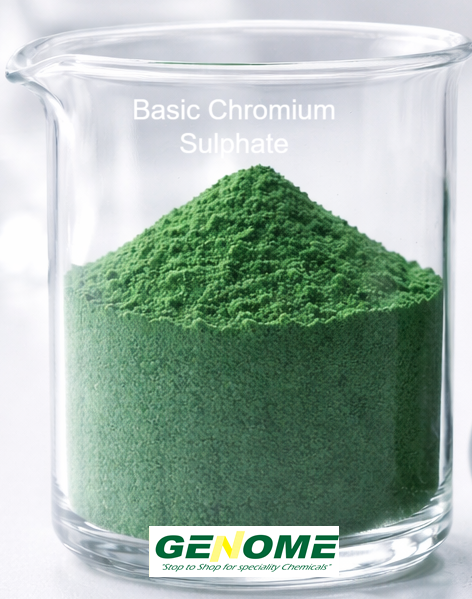
Commercial BCS is typically supplied as a green to bluish-green powder or flakes and is readily soluble or dispersible in water, depending on its composition and grade.
Chemical Properties Basic Chromium Sulfate (BCS)
| Property | Description |
|---|---|
| Chemical name | Basic Chromium Sulfate |
| Common formula (approx.) | Cr(OH)<sub>x</sub>(SO₄)<sub>y</sub>·nH₂O |
| CAS number | 12336-95-7 (commonly cited) |
| Chromium oxidation state | +3 (Cr³⁺) |
| Molecular weight | Variable (depends on basicity and hydration) |
| Basicity | Typically 30–45% (OH⁻/Cr ratio) |
| Appearance | Green to bluish-green powder or flakes |
| Odor | Odorless |
| Solubility in water | Soluble (forms green solution) |
| Solution pH (10% w/v) | ~2.5–4.0 |
| Hydration | Highly hydrated compound |
| Density | ~1.7–1.9 g/cm³ (bulk, varies) |
| Thermal stability | Stable at room temperature; decomposes on strong heating |
| Decomposition products | Chromium(III) oxide (Cr₂O₃), sulfur oxides |
| Chemical nature | Basic chromium(III) salt |
| Reactivity | Reacts with strong acids and strong bases |
| Redox behavior | Stable Cr(III); does not oxidize easily |
| Coordination behavior | Forms coordination complexes with collagen |
Applications of Basic Chromium Sulfate
Leather Tanning
The principal application of BCS is chrome tanning of animal hides and skins.
Used in the production of leather for footwear, upholstery, automotive interiors, garments, bags, furniture, and other leather products.
Textile and Dyeing Applications
used in selected dyeing and mordant applications.
Their suitability depends on the specific textile process and applicable environmental regulations.
Pigment and Industrial Applications
used in pigment and specialty industrial applications.
However, the suitability of Basic Chromium Sulfate specifically depends on the required chemistry, processing conditions, and final product specifications.
Basicity Basic Chromium Sulfate (BCS)
Common BCS Basicity Grades
available in different basicity ranges, such as:
- 30–33% basicity
- 33% basicity
- 38–42% basicity
- Other grades according to specific manufacturer specifications
The appropriate basicity depends on the hide type, tanning recipe, process conditions, and required properties of the finished leather.
Grades of BCS:
Water insolubles:
This measures the amount of insoluble impurities. A lower percentage (typically <0.1%) indicates a higher-purity product.
Iron (Fe) content:
Low iron content is desirable because , presence of iron can discolor the leather.
Hexavalent chromium (Cr6+) content:
This is a crucial safety parameter. Hexavalent chromium is highly toxic and a known carcinogen.
All commercial grades of BCS must have non-detectable or extremely low levels of Cr6+ to comply with environmental and safety regulations.
The production process is specifically designed to reduce all Cr6+ to the safer Cr3+ state.
pH of the solution: The pH of a BCS solution (typically a 2% or 10% solution) is another indicator of its properties and can be a specification.
These grades and specifications are essential for tanners to select the appropriate product for their specific processes and desired leather characteristics.
Reviews
There are no reviews yet.