
Description
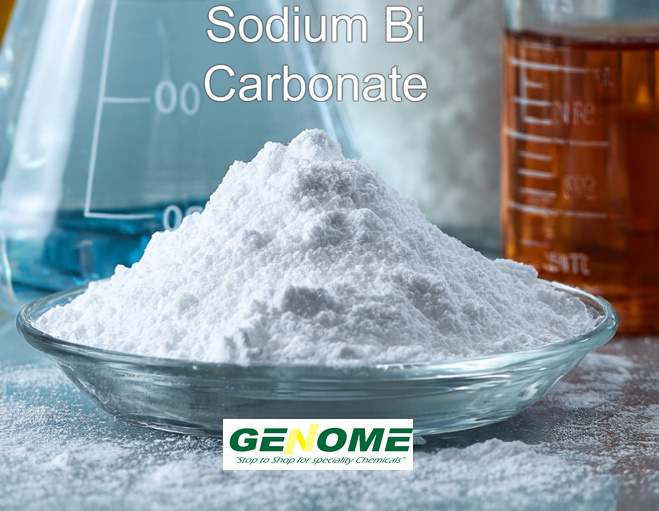
Genome Specialities FZC supplies high-purity Sodium Bicarbonate, a premium-quality white crystalline powder widely known as baking soda or bicarbonate of soda. Our Sodium Bicarbonate meets stringent quality standards and is widely used across the pharmaceutical, food, personal care, and industrial sectors for its exceptional purity, consistency, and performance.
It’s a white, crystalline powder that usually appears as a fine powder. It has a slightly salty, alkaline taste and is a weak base.
Physical Properties of Sodium Bi Carbonate
| Property | Value |
| Appearance | White crystalline powder or granules |
| Odor | Odorless |
| Taste | Slightly salty, alkaline taste |
| Melting Point | Decomposes before melting (~270 °C) |
| Boiling Point | Not applicable (decomposes before boiling) |
| Solubility in water | ~96 g/L at 20 °C (moderately soluble) |
| Solubility in alcohol | Insoluble |
| Density | ~2.20 g/cm³ (solid) |
| Bulk density | ~1000 kg/m³ (varies with granule size) |
| Vapor pressure | Negligible |
| Flash point | Not flammable |
| Hygroscopicity | Slightly hygroscopic |
Applications of Sodium Bi carbonate
Food and Baking Industry
In Cooking: It’s a primary ingredient in baking soda and baking powder as a leavening agent.
Pharmaceutical Applications.
It’s an effective antacid that neutralizes excess stomach acid, providing relief from heartburn and indigestion.
In Cleaning and Deodorizing: Its mild abrasive and deodorizing properties make it useful for cleaning surfaces, absorbing odors in refrigerators, and as a component in homemade cleaning solutions.
Personal Care:
Tooth Paste formulations
Oral care products
Bath Bombs
Cosmetic Application
Fire Extinguishers:
used in some dry-chemical fire extinguishers,
helping to suppress fires by reducing oxygen availability.
Grades of Sodium BiCarbonate
1. Food Grade Sodium BiCarbonate :
common grade sold in grocery stores as baking soda.
Baking: As a leavening agent , pH control: Used in food processing to adjust acidity.
2.Pharmaceutical Grade
This is the highest-purity grade of sodium bicarbonate, meeting the stringent standards of organizations like the United States Pharmacopeia (USP) and the National Formulary (NF).
It is essentially food-grade with an even higher level of purity (often exceeding 99.9%) and undergoes extensive quality control and batch testing to ensure it’s safe for medical use.
Its applications include:
Antacids: As an active ingredient in over-the-counter antacid tablets and effervescent powders to neutralize stomach acid.
Medical treatments: Used in intravenous (IV) solutions to treat conditions like metabolic acidosis, which is an excess of acid in the body’s fluids.
3. Technical (Industrial) Grade
This grade is a cost-effective option for non-food and non-medical applications.
Flue gas treatment: Used to remove pollutants from industrial emissions.
Cleaning and blasting: Abrasive properties make it effective for cleaning and paint stripping.
Water treatment: Used to adjust the pH in water treatment facilities and swimming pools.
Fire extinguishers: Found in some dry-chemical extinguishers to smother fires by releasing carbon dioxide (CO2) gas.


Reviews
There are no reviews yet.