

Description
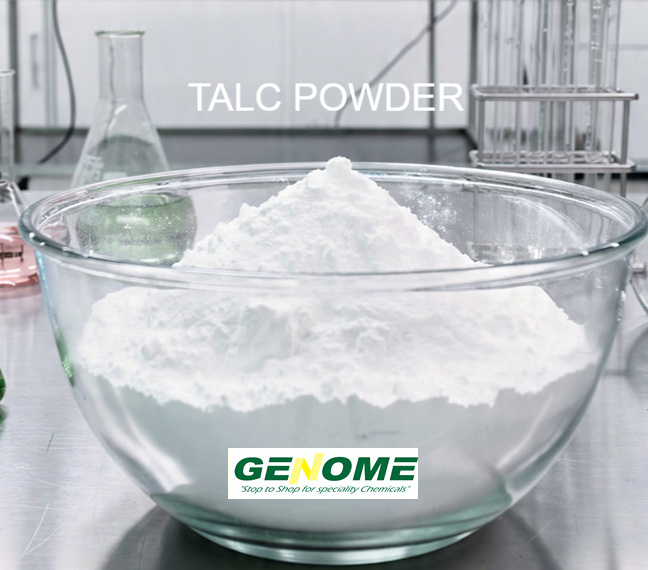
Genome Specialities fzc is a trusted talc powder supplier, providing high-quality hydrated magnesium silicate (Mg₃Si₄O₁₀(OH)₂) for a wide range of industrial and commercial applications.
Talc is a naturally occurring mineral known for its exceptional softness, high whiteness, excellent moisture absorption, and low abrasiveness, making it one of the most versatile minerals used across multiple industries.
With a Mohs hardness of just 1, talc is the softest naturally occurring mineral. Its outstanding thermal stability, chemical inertness, and smooth texture make it an ideal ingredient for cosmetics, plastics, paints, paper, ceramics, pharmaceuticals, food processing, and agricultural products.
Physical and Chemical Properties
| Property | Value |
| Physical State | Solid (powder) |
| Melting Point | > 1500°C |
| Solubility in Water | Insoluble |
| pH (in slurry) | 7 – 9 |
| Density | ~2.7 – 2.8 g/cm³ |
| Hardness (Mohs scale) | 1 (very soft) |
| Flammability | Non-flammable |
Common uses include of Talc Powder
Cosmetics and Personal Care:
Widely known as the main ingredient in talcum and baby powder to absorb moisture, prevent chafing, and provide a smooth feel. It is also used as a base and filler in various makeup products.
Industrial Applications:
Plastics and Rubber:
Used as a filler to improve stiffness, heat resistance, and dimensional stability. It also acts as an anti-sticking agent.
Paints and Coatings:
Serves as an extender and matting agent, improving opacity and smoothness.
Paper:
Used as a filler to enhance brightness, opacity, and smoothness.
Ceramics:
Acts as a flux to lower firing temperatures and improve the strength and durability of ceramic products.
Other Applications:
Pharmaceuticals:
Used as a glidant to assist with the flow of tablet ingredients during manufacturing.
Food: Used as an anti-caking agent (E553b in the EU).
Agriculture:
Used as a carrier for insecticides and pesticides.
Key Benefits of Talc Powder
Exceptional softness and smooth texture
Excellent moisture absorption
Reduces friction and improves lubrication
High whiteness and brightness
Chemically inert and non-reactive
Superior thermal stability
Enhances product durability and dimensional stability
Cost-effective mineral filler for industrial applications

Reviews
There are no reviews yet.