

Description
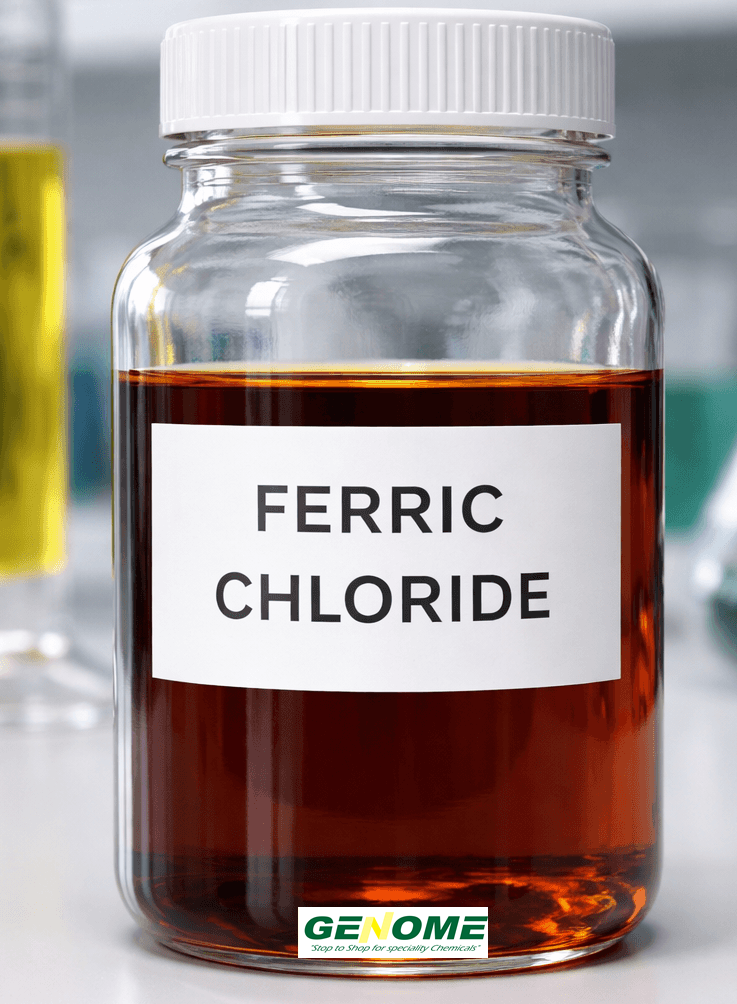
Genome Specialities is a chemical supplier offering ferric chloride for a range of industrial applications.
Ferric Chloride (FeCl₃), also known as Iron(III) Chloride, is a versatile inorganic chemical widely used across water treatment, wastewater management, electronics, metallurgy, chemical processing, and other industrial applications. Genome Specialities supplies ferric chloride for industrial and commercial applications, with a focus on consistent quality, reliable supply, and professional chemical solutions
We aim to provide customers with dependable product quality, consistent supply, and technical support for chemical procurement requirements.
Our ferric chloride solutions can be considered for applications including:
- Water and wastewater treatment
- Industrial effluent treatment
- PCB and copper etching
- Metal processing
- Chemical manufacturing
- Pigment production
- Textile and dye applications
Chemical Properties of Ferric Chloride
| Property | Specification |
| Chemical Name | Ferric Chloride / Iron(III) Chloride |
| Chemical Formula | FeCl₃ |
| CAS Number | 7705-08-0 |
| Molar Mass | 162.20 g/mol |
| Appearance – Anhydrous | Dark green to brown-black crystalline solid |
| Appearance – Aqueous Solution | Yellowish-brown to brown solution |
| Melting Point | Approximately 306–307 °C |
| Boiling Point | Approximately 316 °C; decomposes |
| Density | Approximately 2.9 g/cm³ |
| Solubility | Highly soluble in water; soluble in alcohol and acetone |
| Nature | Hygroscopic and acidic in aqueous solution |
| Odor | Faint, pungent, hydrochloric-acid-like odor |
Industrial Applications of Ferric Chloride
Water & Wastewater Treatment
Ferric chloride is widely used as an inorganic coagulant for water purification and wastewater treatment. It helps remove suspended solids, colloidal particles, organic matter, and phosphorus compounds.
Its applications include:
Drinking water treatment
Municipal wastewater treatment
Industrial wastewater treatment
Sewage treatment
Phosphate removal
Sludge conditioning
Odor control
Reduction of hydrogen sulfide (H₂S) in wastewater systems
Ferric chloride is particularly valuable in phosphorus removal because reducing phosphate levels can help limit eutrophication and excessive algae growth in receiving waters.
PCB Manufacturing & Metal Etching
Ferric chloride is a commonly used etching chemical for copper and other metals. In electronics manufacturing, it is used to etch unwanted copper from printed circuit boards (PCBs), helping create the required circuit pattern.
Metal engraving
Artistic etching
Copper etching
Printed circuit board production
Metallurgical applications
Chemical Synthesis
used as a reagent or catalyst in selected chemical synthesis processes and industrial reactions.
Pigments & Dyes
Ferric chloride finds applications in the production and processing of certain pigments.
Photographic & Specialty Chemical Applications
Used in photographic and specialty chemical processes where its oxidizing and acidic properties are beneficial.
Reviews
There are no reviews yet.